If you've ever watered a plant, come back an hour later and found the soil bone dry underneath, you've met Perth's real problem. Our coastal sand is hydrophobic — it develops a waxy coating that repels water outright, so it runs off the surface or straight past the root zone without ever soaking in. Every dollar you spend on plants is wasted if you haven't dealt with that first.
The short version
Fix the soil before you buy a single plant. Use a wetting agent twice a year. Mulch to 75mm and keep it there. Water deeply on your rostered days rather than lightly every day. Choose plants that already like it here.
Everything below is the detail behind those five things.
1. The soil is the whole job
Perth's coastal plain sand drains almost instantly and holds very little nutrient. Water goes through it like a sieve, taking fertiliser with it. So the fix isn't more water — it's giving the sand something to hold water with.
What to add
- Compost or organic matter through the top 30cm. This is the single biggest improvement you can make. It gives roots something to grip and holds moisture between waterings.
- Bentonite clay if you want a longer-term fix. Clay particles bind to sand and dramatically improve water-holding capacity. It's more work up front and it doesn't wash away.
- A soil wetting agent to break the waxy coating. Water it in until it foams — that's how you know it's activated and working.
Timing matters. Apply wetting agent at the start of winter and again in early spring before the heat arrives, then every three to four months if you've got patches that stay dry. Autumn is the best window for adding organic matter, because the winter rain works it in for you.
2. Mulch is not decoration
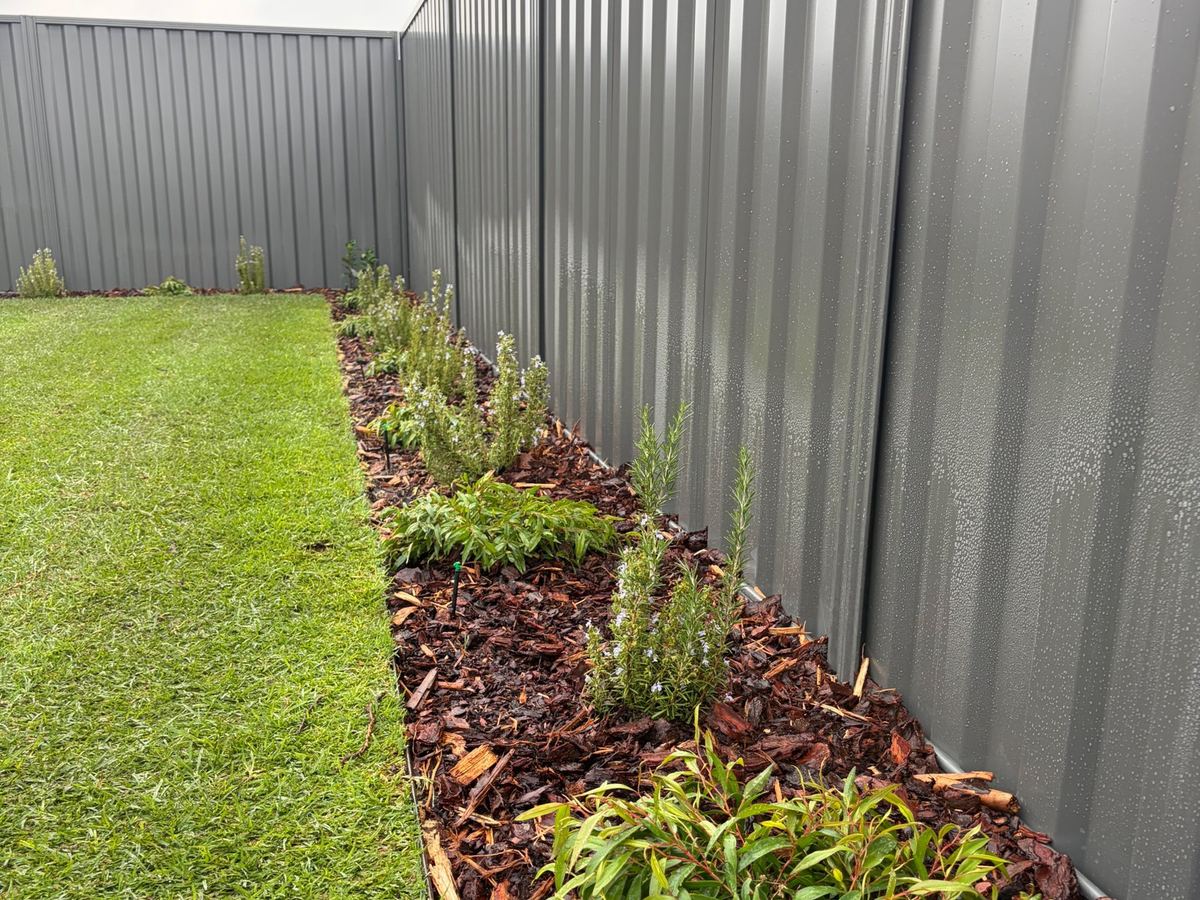
Without mulch, Perth sun bakes moisture out of bare soil within minutes of watering. Mulch keeps the root zone cool, cuts evaporation dramatically, and suppresses the weeds that would otherwise compete for what little water is down there.
- 75mm deep. Thinner and it doesn't insulate; much thicker and water struggles to get through to the soil.
- Coarse and chunky beats fine. Fine mulch mats down and repels water almost as badly as bare sand does. You want something water passes through.
- Keep it off the stems. Mulch piled against a trunk holds moisture there and causes collar rot. Leave a gap of a few centimetres.
- Top it up annually. It breaks down, which is a good thing — that's it feeding your soil — but it means the depth drops each year.
3. Watering: deep and rarely beats little and often
Perth and Mandurah run a two-day sprinkler roster, and your days are set by the last digit of your street number. Sprinklers can run once per day on a rostered day, before 9am or after 6pm. Between 1 June and 31 August, the winter switch-off stops sprinklers entirely.
The mistake most people make is watering lightly and often. Shallow watering trains roots to sit near the surface, where they cook the first time you miss a day. Most plant roots live in the top 30cm, so you want enough water to wet that whole depth, then nothing until the next rostered day.
New lawn or garden? You need an exemption.
Newly laid turf and new planting need water more often than the roster allows while they establish. There's no automatic exemption — you apply for a temporary one through Water Corporation, not your council. Breaches of the roster attract fines, and inspectors do enforce it. Check your rostered days with Water Corporation's postcode lookup.
Getting your retic right
- Matched nozzles. If heads on the same station throw at different rates, half your lawn is over-watered while the other half is dry. It's the most common cause of a patchy lawn.
- Drip to the beds. Buried under mulch, drip line puts water at the roots with almost nothing lost to wind or evaporation.
- Check for overspray. Water landing on your driveway is water you're paying for, and a sprinkler soaking the footpath is exactly what gets noticed.
- Run it while you're watching, twice a year. Every station, one at a time. A blocked head or a split line is invisible until you go looking.
4. Mowing heights, by variety
Cutting too short is the fastest way to stress a lawn in summer. Longer blades shade the crown and the soil beneath it, so the ground stays cooler and holds moisture longer. As a rule, never remove more than a third of the leaf in one cut.
| Variety | Height | Frequency in season |
|---|
| Buffalo | 30–40mm | Weekly, or fortnightly in cooler months |
| Wintergreen couch | 25–30mm | Weekly — it grows fast in full sun |
| Kikuyu | 30mm | Weekly, more often through a growth flush |
Raise the mower by 10mm heading into summer. It looks slightly shaggier and it will save your lawn in a heatwave.
5. What to do, season by season
Sep – Nov
Spring
- Wetting agent through lawn and beds before the heat
- Nitrogen-rich fertiliser as growth picks up
- Sprinklers back on from 1 September — test every station
- Best window for laying new turf
- Top up mulch to 75mm
Dec – Feb
Summer
- Raise mowing height to shade the crown
- Spot-treat dry patches with wetting agent
- Deep soak on rostered days, never a light sprinkle
- Watch for black beetle damage in the lawn
- Shade cloth over anything struggling in a heatwave
Mar – May
Autumn
- Best time of year for planting natives
- Dig compost and organic matter through beds
- High-potassium feed to strengthen roots for winter
- Overseed thin patches while soil is still warm
- Last granular feed by mid-May
Jun – Aug
Winter
- Sprinkler switch-off — retic off entirely, 1 June to 31 August
- Wetting agent so winter rain actually penetrates
- Prune and shape while growth is slow
- Clear debris from beds to limit pests and disease
- Plan and prep for spring planting
Do it yourself: fixing a dry patch
That one bit of lawn that stays brown no matter how much you water it is almost always hydrophobic soil, not a retic fault. Here's the weekend fix.
Check it's not the retic first
Run that station and watch. If a head is blocked, sunk below the grass or throwing the wrong way, no amount of soil work will help. Fix that and you may be done.
Test the soil
Pour a cup of water on the dry patch. If it beads and sits on the surface instead of soaking straight in, the soil is repelling water. That's your answer.
Aerate the area
Push a garden fork in 10–15cm deep and rock it slightly, every 10cm across the patch. This opens channels for water and wetting agent to actually get down there.
Apply wetting agent
Granular or liquid, both work. Follow the rate on the pack and water it in thoroughly — until it foams. That foam means it's activated.
Top-dress with a compost and sand mix
About 10mm over the patch, worked into the holes you just made. This is what gives that soil something to hold water with long term.
Water deeply, then leave it
One good soak on your next rostered day. Resist watering it daily — you want roots chasing moisture downward, not sitting at the surface.
If it's still dry after a month, the problem is usually deeper than the surface: compaction, buried builder's rubble, or a retic zone that never had proper coverage to begin with. That's worth a look from someone with a shovel.
Why a living garden is worth the trouble
It's tempting on a sand block to pave the lot and be done with it. Worth knowing what you'd be giving up.
- It's measurably cooler. Lawn and planted beds sit far cooler than paving or artificial turf on a 40°C day. That difference reaches the house — shade and planting around a west wall cuts what your air conditioner has to fight.
- It handles rain. Planted ground absorbs a downpour. Hard surfaces send it to the drain, and on a small block that means water pooling where you don't want it.
- It brings things in. Grevillea and kangaroo paw in a Perth garden will have honeyeaters visiting within a season. Kids notice that. So do you.
- It gets better. Paving looks its best the day it's laid and slowly declines. A garden does the opposite — the beds fill out, the tree throws shade, and by year three it looks like it belongs there.
Waterwise doesn't mean lifeless. A native garden planted in improved soil, properly mulched and on drip, uses very little water once established — and it looks alive doing it.
Common questions
How often should I use wetting agent?
Twice a year as a baseline — start of winter so the rain penetrates, and early spring before the heat. If you have patches that stay dry, spot-treat them every three to four months. Always water it in until it foams; that's the sign it's activated.
Can I fertilise and apply wetting agent on the same day?
Yes. Apply the wetting agent first and water it in, then spread the fertiliser and give it another soak. Doing it in that order means the fertiliser actually reaches the root zone instead of sitting on hydrophobic soil.
Which watering days am I on?
Your rostered days are set by the last digit of your street number, not by your suburb or council. Water Corporation has a postcode lookup that will tell you. Sprinklers run once per day on a rostered day, before 9am or after 6pm, and not at all between 1 June and 31 August.
Do native plants really need no water?
Low maintenance, not no maintenance. The first one to two summers need regular deep watering while roots establish. After that, a native garden in improved soil usually gets by on a weekly summer soak on rostered days — and some mature native gardens need almost no scheme water at all.
When's the best time to plant?
Autumn to early winter, once the first rains arrive. Planting then gives roots six or seven months of development in moist, still-warm soil before their first summer. Avoid planting through summer — establishing new plants in hot hydrophobic sand rarely ends well. Turf is the exception; spring works well because it establishes fast in warm soil with an exemption in place.
General guidance for Perth and the Swan Coastal Plain. Watering roster rules, rostered days and exemption conditions are set by Water Corporation and can change — always confirm your own days and any exemption directly with them.